
It's worth taking a minute to understand a little bit of the story of how Hong Kong came to be the place that it is.
In the 1830's, the British were selling lots of opium (from British India) to China. This was having a devastating effect on Chinese society in the form of opium addiction. As such, China passed laws banning the sale of opium and confiscated some British shipments of the stuff. There was disagreement, and then a war, which China lost because the British Navy is the British Navy. As part of the treaty that ended hostilities in this so-called First Opium War in 1842, China ceded the island of Hong Kong to the British "in perpetuity," i.e. forever. Why is it Chinese again, if the treaty said it had been ceded forever? We'll get to that, but for now it's worth noting that this treaty marks the start of what China calls the "Century of National Humiliation."
So in 1842, the island of Hong Kong, the dark blue bit below, became British.
Less than two decades later, the Second Opium War took place, from 1856 to 1860. It culminated in the Convention of Peking which, for the purposes of our story, ceded, again in perpetuity, Kowloon Peninsula and Stonecutter's Island to the British. The demarcation point for Kowloon Peninsula is known today as Boundary street, which I've highlighted in red below
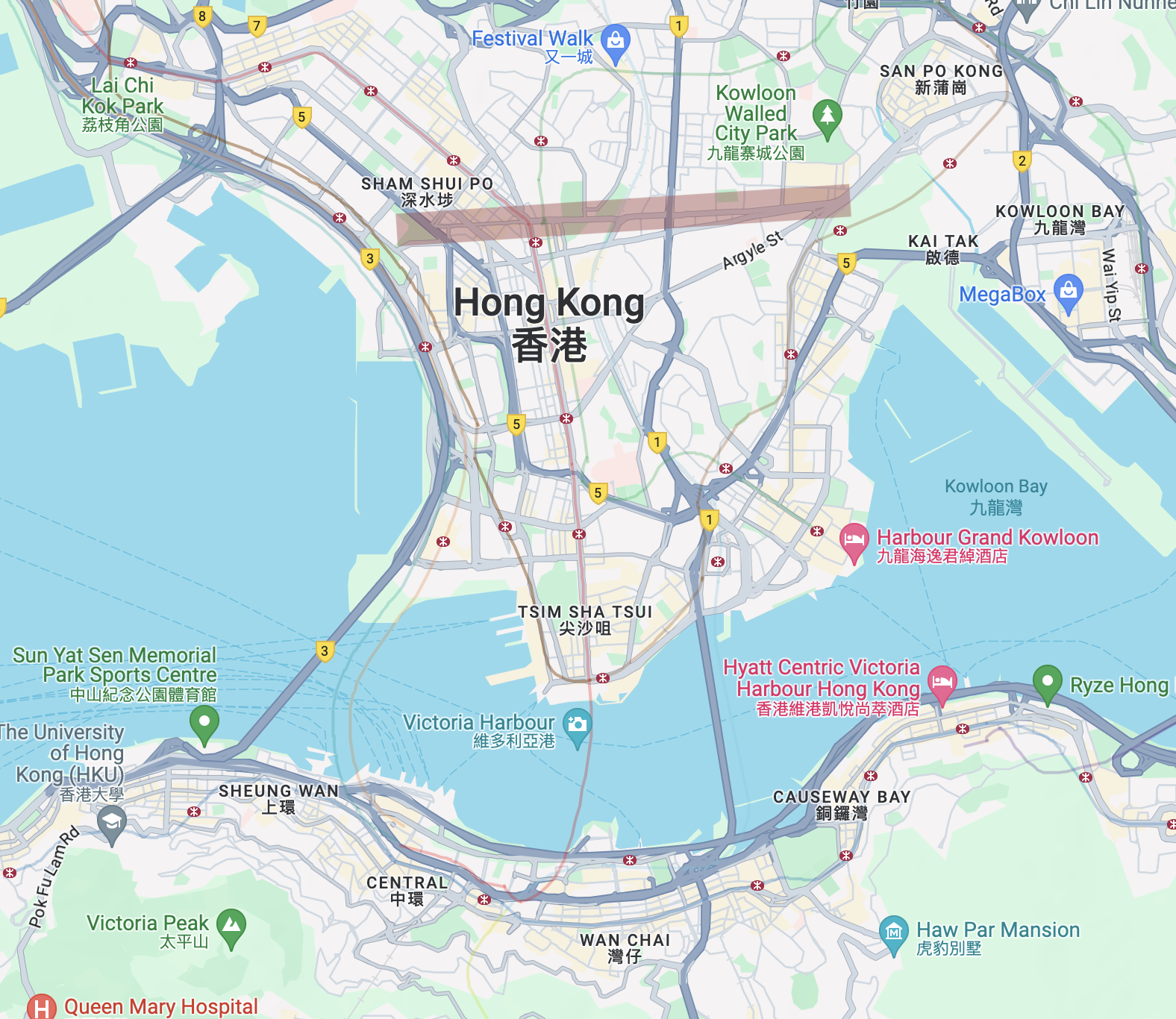
Lastly, in 1898 the Chinese government and the British empire signed the Second Convention of Peking which leased the "New Territories" to the British for 99 years. Why 99 years? The British diplomat arranging all this said that 99 years was "as good as forever," although that's not a very satisfying reason. Perhaps it was some sort of negotiating tactic.
Let's fast forward to the 1980's. 1997 is coming up, and by the terms of the treaty that's when the lease ends. The British were interested in renewing the lease, or even entering into some sort of arrangement whereby the territory of Hong Kong would become Chinese but would still be administered by the British. However, the Chinese would have none of it. They considered the previous treaties to be unequal, and they wanted all of the territory back, including the parts that had been ceded in perpetuity. Britain considered keeping Hong Kong Island, but quickly realized it would be impractical. The territory had never made a distinction between areas that has been ceded in perpetuity and areas that were leased, so all infrastructure was tightly coupled.
Now, I'm not familiar with all the details of the negotiations, but despite the fact that the British agreed to leave Hong Kong, the handover agreement stipulated that Hong Kong would retain separate legal and economic systems from "mainland China" for at least 50 years post-handover. I suppose the British were trying to "do right" by their soon-to-be-former colonists and do something to try to preserve the freedoms that people of Hong Kong enjoyed.
I think there was also an economic component to this. In 1983, when negotiations were ongoing, the GDP of Hong Kong was $30 billion, while the GDP of China was $300 billion. Of course, Hong Kong had far fewer people than mainland China, and so it had a GDP per capita of $5,600 whereas for China it was $298. Moreover, Hong Kong was in a unique position to help China with the reforms recently started by Deng Xiaoping to liberalize the economy. The point is that by virtue of wealth, as well as unique expertise, Britain had some leverage at the negotiating table to ask for greater freedoms for the people of Hong Kong.
And so in 1997, the territory was handed over to the Chinese with great fanfare. And so started a 50 year clock.
Let's fast forward to 2024. The GDP of Hong Kong is $360 billion, while the GDP of China as a whole is $17.963 trillion! Per capita rates are $48,984 and $12,720, respectively. And there are other major cities in China that know how to do business with the West, like Shenzhen and Shanghai. China has less need for Hong Kong's money or its unique skills than it did in the past. And they really want to integrate HK with the rest of China. Slowly but surely they've been passing laws curtailing people's freedoms. There were massive protests against these, including protests in which nearly 2 million people participated! There's only 7 million people in Hong Kong in total! And yet, despite some initial backpedaling, China ultimately got the laws it wanted.
The era of Hong Kong as a unique city is slowly closing. Companies that want to engage with east asia are finding friendlier cities to put their headquarters, like Singapore or Seoul. Some even set up shop in China itself. I suppose that one day the border between Hong Kong and mainland China will cease to exist. It'll be a while, and there's so much that needs to take place before then. And some remnants of colonial rule will always remain (getting everyone to drive on the right seems like a particularly thorny challenge), but the direction is clear. It's a little bit sad, as this is such a unique city and some of that uniqueness is slowly fading, but for my part I can say that I'm grateful I had the opportunity to experience this vibrant city and I hope it remain vibrant and retains its vitality despite the challenges ahead of it. ❤